


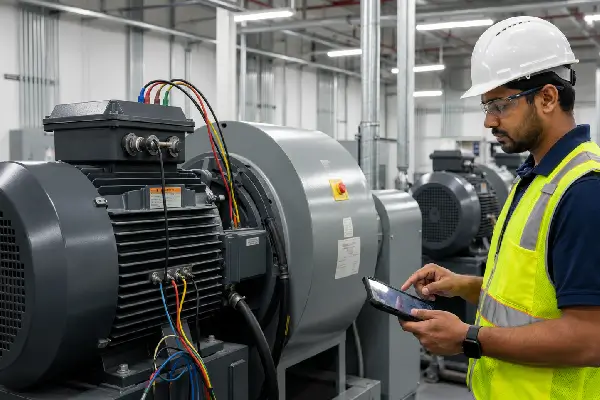
Motor Current Signature Analysis
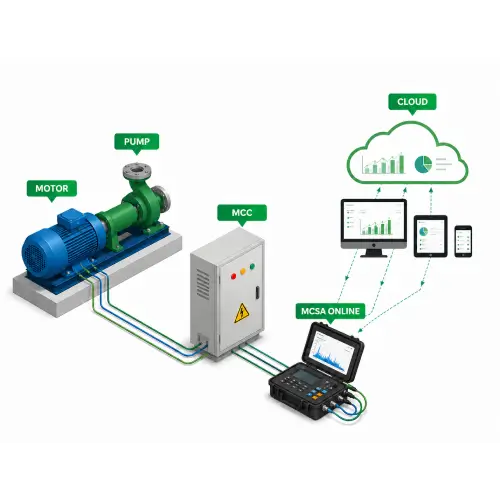
MCSA-Online Delivers intelligent motor health monitoring through advanced motor current signature analysis. It identifies faults long before they lead to failures. The result: safer, more efficient, and more reliable operations.
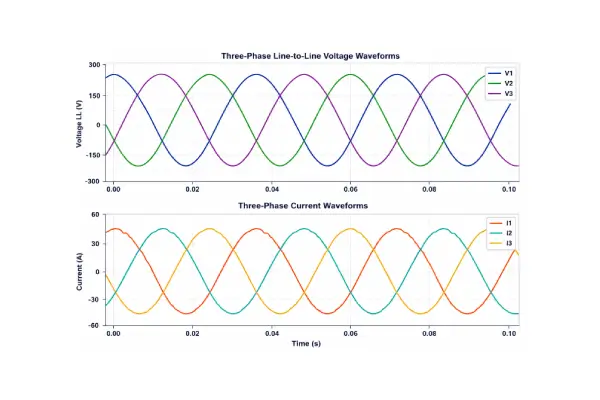
With all three phases of voltage and current acquired simultaneously, MCSA Online performs complete symmetrical component analysis alongside full MCSA — covering every fault class with zero ambiguity.
Current as a Carrier
Direct electromagnetic output monitoring. Rotor and mechanical anomalies modulate the signal for deep diagnostic insights.
Symmetrical Components
Decomposes signals into positive, negative, and zero sequences to detect phase unbalance and ground faults.
Slip & Speed Estimation
Precise supply frequency reference combined with spectral analysis resolves motor slip accurately without external sensors.
FFT Spectral Decomposition
Converts time-domain signals into high-resolution frequency spectrums to isolate mathematically defined fault offsets.
Full 3-phase voltage and current acquisition is essential for accurate motor condition monitoring and reliable fault analysis. While a single phase can reveal certain mechanical fault signatures, many critical electrical issues remain undetectable without simultaneous monitoring of all three phases.
MCSA Online's advanced 8-channel architecture captures complete three-phase data to accurately identify voltage unbalance, negative-sequence components, single-phasing, zero-sequence ground currents, and other electrical abnormalities. This comprehensive monitoring approach eliminates blind spots and provides a clear, real-time view of motor health, power quality, and overall system performance for effective predictive maintenance and fault diagnosis.
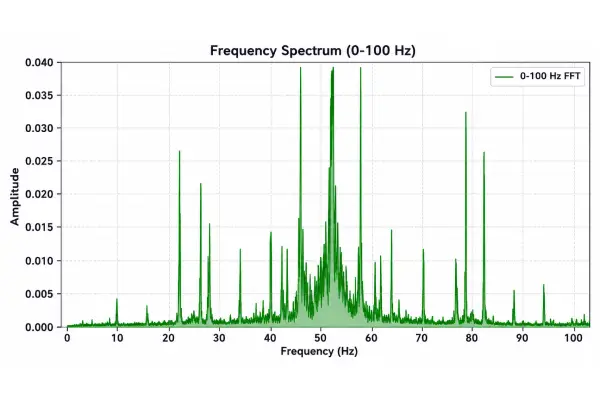
Every machine fault generates a unique and mathematically predictable frequency signature within the current signal. MCSA Online continuously monitors these spectral patterns in real time and compares them against established severity thresholds for accurate fault detection and condition monitoring. This advanced fault frequency analysis helps identify electrical and mechanical issues early, improving machine reliability, reducing downtime, and supporting predictive maintenance strategies.
Rotor
Dynamic Eccentricity
A rotating air-gap asymmetry creates sideband clusters around rotor slot harmonics in the current spectrum, with amplitude proportional to the degree of eccentricity.
Broken Rotor Bar
Asymmetric rotor resistance modulates air-gap flux, generating characteristic sidebands around the supply frequency and its odd harmonics in the current spectrum.
Static Eccentricity
A fixed-position air-gap non-uniformity modulates the supply fundamental and introduces even harmonic distortion detectable in the current total harmonic distortion.
Stator
Stator Inter-Turn Short
Shorted turns create an asymmetric winding that increases harmonic content — particularly 3rd and 5th harmonics — and raises the overall current THD beyond baseline.
Bearing
Inner Race & Ball Fault
Inner race and ball spin frequencies generate amplitude-modulated sidebands around supply harmonics, with modulation depth increasing as the bearing defect progresses.
Outer Race Fault
The ball pass frequency (outer race) modulates motor current via air-gap variation and torque ripple, producing sidebands around supply frequency multiples at incipient stage.
MCSA Online delivers comprehensive motor condition monitoring by simultaneously analyzing all three phases of voltage and current in real time. The system detects every fault identifiable by portable MCSA solutions while also providing advanced 3-phase-exclusive diagnostics for complete motor and power supply health analysis.
Complete Coverage
With full three-phase monitoring, MCSA Online eliminates blind spots, hidden faults, and assumed phase balance conditions. The advanced diagnostic system accurately identifies electrical and mechanical abnormalities, ensuring reliable fault detection, improved machine performance, reduced downtime, and enhanced predictive maintenance capabilities.
Rotor
Broken / Cracked Rotor Bars
MCSA sideband detection across all three phases simultaneously for higher confidence.
End-Ring Fracture
Torque ripple modulation confirmed across all phases for unambiguous diagnosis.
Dynamic Eccentricity
Rotating air-gap imbalance — sidebands resolved with enhanced confidence via 3-phase cross-check.
Static Eccentricity
Fixed-position air-gap asymmetry — cross-phase comparison eliminates false positives.
Mixed Eccentricity
Static + dynamic combination fully distinguished via 3-phase symmetrical component analysis.
Stator
Inter-Turn Short — Any Phase
Shorted turns detected and phase-isolated in Phase 1, 2, or 3 via cross-phase THD comparison.
Winding Insulation Degradation
Per-phase insulation trending across all three windings simultaneously.
Coil-to-Coil Short — Any Phase
Phase-specific isolation enables targeted maintenance without motor teardown.
Power
Supply Voltage Harmonics (THDv)
5th, 7th, 11th, 13th harmonic distortion measured per phase from three voltage channels.
Supply Frequency Deviation
Grid frequency tracked in real time from three voltage references for high accuracy.
VFD / Inverter-Induced Harmonics
PWM carrier and inter-harmonics isolated and flagged across all three phases.
Power Factor Degradation
Per-phase and total PF tracked in real time with trend monitoring.
Motor Efficiency Decline
True 3-phase efficiency index computed from all six channels — no balance assumption.
Voltage Sag / Swell Events
Per-phase voltage anomalies captured and time-stamped across all three voltage channels.
High Impedance / Connection Fault
Loose terminals and cable degradation detected via per-phase impedance variation.
Bearing
Outer Race Defect (DE / NDE)
BPFO sidebands confirmed across phases for incipient detection.
Inner Race Defect
BPFI sidebands with amplitude modulation at rotational frequency.
Rolling Element (Ball) Defect
BSF sidebands with cage frequency modulation across 3-phase spectrum.
Lubrication Degradation
Elevated broadband noise floor and rising bearing frequency amplitudes over time.
Mechanical
Shaft / Coupling Misalignment
1× and 2× running speed sidebands via torque modulation, confirmed cross-phase.
Mass Imbalance (Rotor / Fan / Impeller)
1× rotational frequency confirmed across all three current channels.
Mechanical Looseness
Sub-harmonic components confirmed across phases for unambiguous detection.
Gear Mesh Faults (Gearbox)
GMF and sidebands detected via load torque modulation in all three phases.
Broken / Chipped Gear Tooth
Impulsive torque at GMF confirmed across phases for high-confidence diagnosis.
Coupling Wear / Belt Tension Fault
Belt defects and coupling wear confirmed across three current signatures.
Load
Pump Cavitation
Blade pass frequency and broadband noise confirmed across all three phases.
Fan Blade Pass Anomaly
Blade pass modulation cross-verified across three-phase current signatures.
Cyclic / Pulsating Load Torque
Torque-driven sidebands at load cycle frequency observed across all phases.
Motor Overloading
Per-phase and total load index computed from true 3-phase power measurement.
Motor Underloading / No-Load Running
True 3-phase load index below threshold detects process-side faults.
Phase Voltage Unbalance
Voltage magnitude differences between all three phases computed per IEC / NEMA standards. Triggers derating alerts and predictive failure warnings.
Phase Current Unbalance Quantification
NEMA current unbalance ratio computed from all three CT inputs simultaneously. Per-phase deviation from mean tracked continuously.
Negative Sequence Component Analysis
Full symmetrical component decomposition (positive, negative, zero sequence). Negative sequence is the earliest detectable indicator of winding asymmetry and supply unbalance.
Single-Phasing Detection (Any Phase)
Loss of any phase — 1, 2, or 3 — detected immediately from all three voltage and current channels. Alarm before motor damage occurs.
Phase-to-Phase Fault Localisation
Short-circuit or high-resistance fault between any two phases isolated to the specific phase pair via differential current analysis.
Stator Fault — Phase Isolation (A, B, C)
Inter-turn shorts in Phase 1, 2, or 3 detected and isolated via cross-phase THD and current magnitude comparison across all three windings.
True 3-Phase Active & Reactive Power
True kW, kVAR, and kVA computed from all three V+I pairs. No balance assumption — accurate even under significantly unbalanced supply conditions.
NEMA / IEC Derating Factor Calculation
Motor derating recommendation computed per NEMA MG1 from three-phase voltage unbalance ratio. Provides standards-compliant output for maintenance documentation.
Phase Rotation / Sequence Fault
Reversed or incorrect phase sequence detected via phase angle measurement across all three voltages — prevents motor from running in reverse direction.
Zero-Sequence Ground Fault Detection
Earth leakage / ground fault detected via zero-sequence current (sum of all three phase currents). Catches insulation breakdown before a trip event or equipment damage.
Full diagnostic capability comparison. ✓ Full ◐ Partial/inferred ✕ Not available.
| Diagnostic Capability | MCSA Portable (2 Channels) | MCSA Online (8 Channels) | Notes |
| Broken Rotor Bar Detection | ✓ Full | ✓ Full | Identical — fault appears in all phases equally |
| Air Gap Eccentricity (Dynamic & Static) | ✓ Full | ✓ Full | Fully resolved from single-phase current spectrum |
| Bearing Outer / Inner Race Faults | ✓ Full | ✓ Full | Equivalent sensitivity; both rely on MCSA |
| Shaft Misalignment & Imbalance | ✓ Full | ✓ Full | Mechanical sidebands appear in all three phases |
| Gearbox Fault (GMF Analysis) | ✓ Full | ✓ Full | Torque modulation appears uniformly across phases |
| Stator Inter-Turn Fault (Monitored Phase) | ✓ Full | ✓ Full | Single-phase covers monitored winding completely |
| Stator Fault — Phase Isolation | ◐ Partial | ✓ Full | 8C localises fault to specific phase A, B, or C |
| Phase Voltage Unbalance | ✕ No | ✓ Full | Requires all three voltage inputs |
| Phase Current Unbalance | ✕ No | ✓ Full | Requires all three current inputs |
| Negative Sequence Component | ✕ No | ✓ Full | Symmetrical component analysis needs 3-phase data |
| Single-Phasing Detection (Any Phase) | ◐ Partial | ✓ Full | 2C detects only if monitored phase is affected |
| Zero-Sequence Ground Fault | ✕ No | ✓ Full | Requires summing all three currents for residual |
| Phase Rotation / Sequence Error | ✕ No | ✓ Full | Phase angle between all three phases must be measured |
| Supply Voltage THD (Per Phase) | ◐ Phase 1 only | ✓ Full (1+2+3) | 8C measures THD independently on all three phases |
| True 3-Phase Active Power (kW) | ◐ Estimated | ✓ Full | 2C assumes balance; 8C computes from all 6 channels |
| Power Factor (Per Phase) | ◐ Phase 1 only | ✓ Full (1+2+3) | 8C computes per-phase PF and total |
| Motor Load Index | ✓ Full | ✓ Full | 8C uses true 3-phase load index; more accurate |
| VFD Harmonic Isolation | ✓ Full | ✓ Full | PWM carrier resolved; 8C cross-validates across phases |
| NEMA Derating Recommendation | ✕ No | ✓ Full | NEMA MG1 derating requires 3-phase voltage unbalance |
Complete motor health intelligence for critical assets where every fault class must be covered and standards compliance is required.
Pump Systems
Full motor health plus true 3-phase power monitoring for accurate duty-standby comparison and energy efficiency tracking.
Wind Turbines
Complete generator health — mechanical, electrical, and supply-side. Full phase unbalance and ground fault monitoring for offshore and onshore assets.
Compressors
Complete compressor motor monitoring with NEMA derating alerts, phase unbalance, and zero-sequence ground fault detection.
Fleet Monitoring
High-value critical motors where the cost of failure justifies comprehensive monitoring — generators, large drives, mission-critical pumps.
Critical Process Motors
High-criticality motors where any fault class must be detected early — zero tolerance for missed alarms or blind spots.
Conveyor Drives
Critical conveyor drives with regulatory compliance requirements — full 3-phase monitoring and standards-compliant reporting.
MCC / Panel Retrofit
Full 3-phase MCC monitoring with a single device replacing multiple single-phase monitors. Standards-compliant power metering included.
Hazardous / Remote Areas
Complete 3-phase monitoring from a safe control room location — no intrusion into the Ex zone or high-temperature area.
Full diagnostic capability comparison. Hardware specifications for panel installation and integration with existing monitoring infrastructure.
| Specification | Value | Details |
| Power Supply | 5V DC | via terminal connection |
| Communications | Ethernet 10/100 Mbps | Modbus TCP · REST API |
| Input Channels | 8 Channels | 3× Voltage 3× Current 2× Spare |
| Voltage Input | Up to 800V AC | Direct input or PT secondary |
| Current Input | CT Secondary | 1A max (3× independent inputs) |
| Sampling Freq. | 10 – 20 kHz selectable | Phase-locked all channels |
| Supply Frequency | 50 / 60 Hz | Averaged across 3 voltages |
| 3-Phase Analysis | Symmetrical Components | Pos/Neg/Zero real-time |
| Installation | DIN Rail 35mm | Panel or JB mounting |
Interturn faults
phase-to-phase faults
Broken/cracked rotor bars
Bearing failure
Static and dynamic rotoreccentricity
Phase Imbalance
Rotor shaft misalignment
Stator winding failure
Mechanical Imbalance
Pump, Gearbox, Belt Pulley,
Blower Fan, Faults
Power Loss Analysis
Remote monitoring
Realtime alerts
Power loss calculation
Power quality analysis
Inrush current analysis
Fault trend charts
Equipment operation history
Harmonics analysis
Non intrusive
Early fault detection
Enhance reliablility
Reduce unplanned downtime
Continuous real-time monitoring